Check your sentiments
BTC volatility driven by liquidations, leverage tripwires, USDT freeze, miner losses, and shifting market sentiment near $65K levels

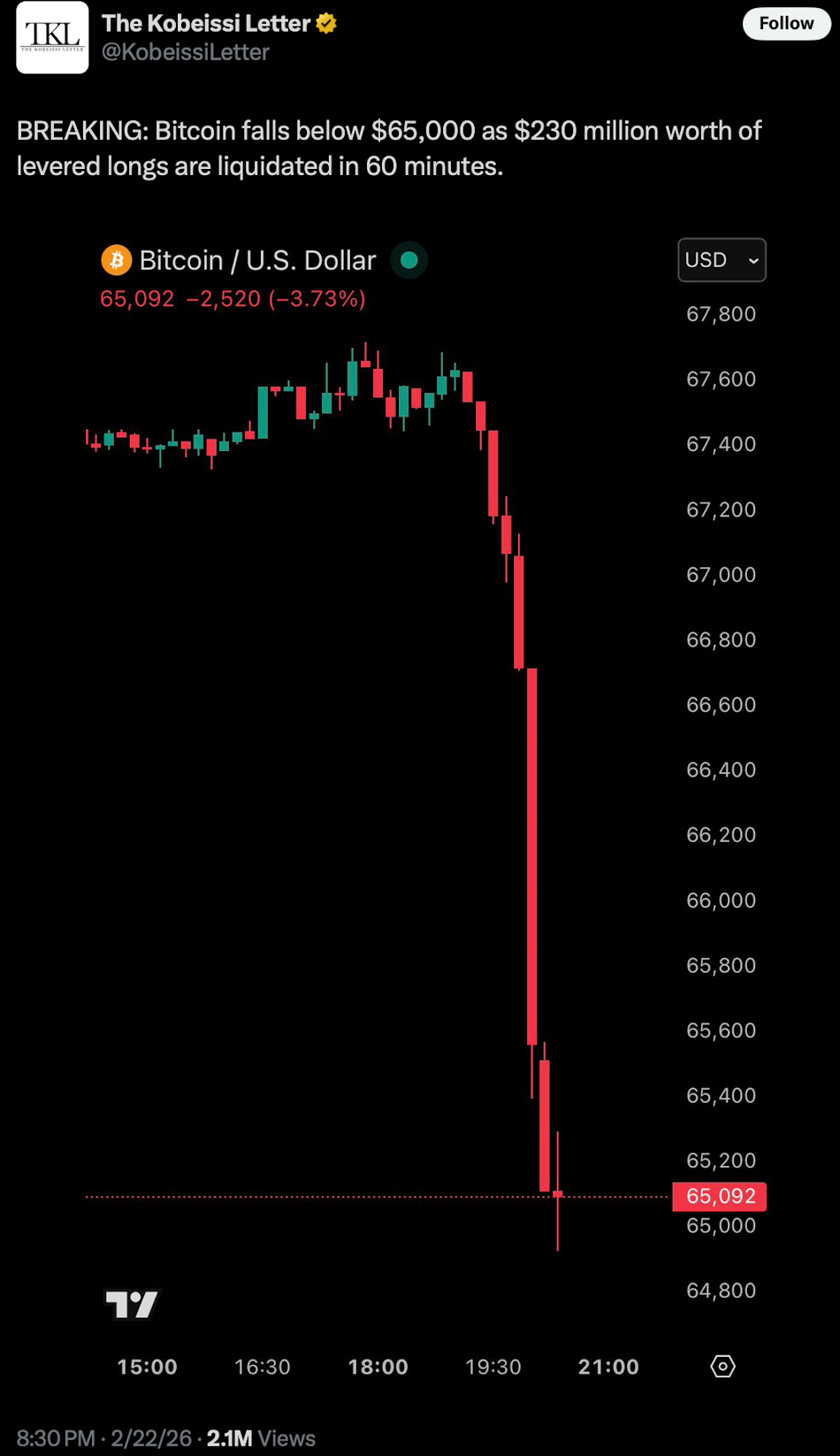
Fast liquidations showed that leverage, not calm conviction, was driving the price move.
-A widely shared market update on X described Bitcoin sliding below $65K while a large wave of “leveraged longs” was forced closed quickly, which is what happens when traders borrow to bet on a rise and the market moves against them. This is a reminder that some price drops are not only people choosing to sell, they are automatic sell orders triggered by margin rules.
Liquidation threshold alerts signaled that specific price lines can act like tripwires.
-A flash update, citing CoinGlass data, warned that if Bitcoin falls below $65K, a very large amount of long positions could be liquidated on major centralized exchanges, and that a move higher could also squeeze short sellers. The point is not the exact number, it is that leverage piles up at predictable levels. When price touches those levels, forced buying or forced selling can cascade, making moves feel sudden and “unfair” to people who are not using leverage.
Stablecoin enforcement showed crypto liquidity can tighten due to policy, not just market sentiment.
-Tether is saying it has frozen $4.2B of its stablecoin, USDT, linked to alleged crime connections. Even though this has nothing to do with Bitcoin in the narrow sense, it matters to Bitcoin trading because stablecoins are widely used as on ramps, off ramps, and trading collateral across exchanges. When stablecoin activity is constrained, some traders become more cautious, because the plumbing that moves dollars around the crypto ecosystem can become harder to use quickly.
A politically connected Bitcoin firm’s loss showed even prominent names are not immune to downturns.
-American Bitcoin, described to be backed by President Trump’s sons, swung to a quarterly loss during a broader crypto selloff. When Bitcoin’s price is under pressure, companies tied to mining, services, or crypto balance sheets can see earnings whiplash, because their revenues and asset values are tightly linked to market cycles. Attention follows recognizable names, even when the core lesson is basic risk exposure.
Miner earnings showed the Bitcoin mining industry remains in survival and reinvention mode.
-MARA Holdings shares rose even after the mining company posted a very large quarterly loss, paired with a pivot toward AI related infrastructure. For non specialists, the key idea is that miners are energy heavy businesses, and their profits depend on Bitcoin’s price, mining difficulty, and operating costs. When conditions tighten, some miners try to diversify into selling computing and data center capacity, because the same buildings and power contracts can support more than one revenue stream.
Sentiment indexes show that market emotion is measurable and likely shifting rapidly.
-Alternative.me’s Crypto Fear and Greed Index exists to compress several inputs into a single number meant to represent how anxious or confident the market feels about Bitcoin. Be cautious however, simply use it to feel the vibe, not as a crystal ball. When the reading is near fear, it often means people are reacting to recent losses and uncertainty, and when it is near greed, it often means people are chasing recent gains. Either extreme can lead to overreaction. Stay humble and stack sats.